
Coffee Machine Cleaner Alternatives: What’s Safe to Use?
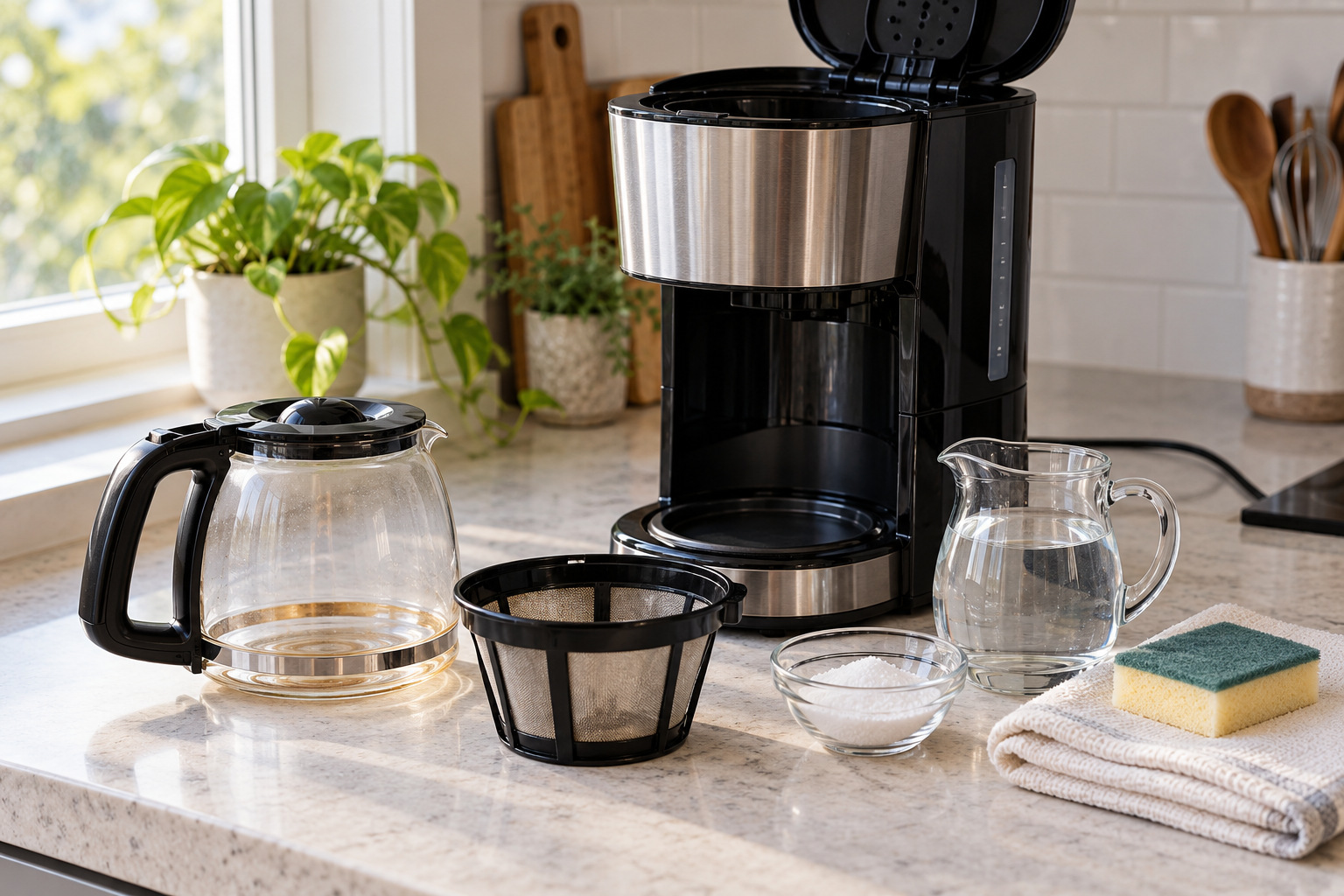
A manufacturer-approved third-party product can replace the original coffee machine cleaner. White vinegar is also an option for certain drip coffee makers, and mild dish soap can clean some removable parts. The right substitute depends on the job and the exact machine: removing limescale, coffee oils, and milk residue requires different treatment.
If you have an automatic espresso machine or a capsule machine, check its instructions before pouring a homemade solution into the tank. A vinegar recipe that works in a basic drip brewer may be explicitly prohibited in another machine—even one from the same brand.
You can save money on maintenance without turning your morning coffee equipment into a kitchen chemistry experiment. Start by identifying which cleaner you actually need.
First, work out what you are trying to remove
As Urnex explains in its cleaning and descaling guide, descaling removes mineral buildup, while cleaning removes coffee oils and residue. A machine can need both.
| The job | What to use | What to check before substituting |
|---|---|---|
| Remove limescale from the water system | A compatible descaler; vinegar only where permitted | Approved ingredients, concentration, and descaling procedure |
| Remove coffee oils from the brewing system | A suitable coffee equipment detergent or cleaning tablet | Whether it is intended for your cleaning cycle, backflushing, or soaking parts |
| Clean a milk circuit or frother | A compatible milk-system cleaner, plus routine rinsing as instructed | The type of milk system and its cleaning requirements |
| Wash removable accessories | Water and mild dish soap where allowed | Which parts can be washed, soaked, or put in a dishwasher |
A descaling tablet and a coffee-oil cleaning tablet are not interchangeable just because both arrive as little white discs. Check the purpose printed on the packet before checking the price.
Can you use a cleaner from another brand?
Yes, when your machine’s manufacturer permits it. Moccamaster USA, for example, recommends Urnex BioCaf and Dezcal descalers, along with BioCaf Cleaner and Cleancaf for cleaning. That is a useful example of a brewer manufacturer recommending products sold under another brand.
Breville’s current support guidance for the Bambino Plus BES500 calls for an approved, machine-compatible descaling solution and specifically excludes vinegar. JURA takes a different approach: its maintenance guidance specifies original JURA products and its descaling tablets.
Look for approval that applies to your model, then follow the replacement product’s instructions. A seller’s claim that a cleaner is “universal” does not settle the question. Different machines can have different restrictions on ingredients and procedures.
When comparing products, calculate the cost per correctly measured cleaning rather than comparing bottle prices alone. A large bottle is less impressive if each cleaning uses half of it.
Can you clean a coffee maker with vinegar?
Some drip coffee makers allow white vinegar for descaling; others do not. Vinegar contains acetic acid, which can dissolve mineral deposits. The issue is compatibility and proper use, rather than whether vinegar has any descaling ability at all.
For example, Mr. Coffee’s guidance for drip brewers describes roughly one part white vinegar to two parts water, followed by two water-only cycles. That is a manufacturer-specific example, not a recipe for every coffee machine.
Philips allows white household vinegar containing 4% acetic acid for certain drip models, including the HD7434/20, HD7431/20, and HD7457/20. Its procedure includes three subsequent water-only cycles.
However, Philips’ automatic espresso machine guidance specifies its own descaler. The section for the 5000 series expressly rules out acetic acid, along with several other acids. Nespresso also prohibits vinegar and warns that unsuitable descaling products may damage its machines.
Check the vinegar’s strength as well as the mixing ratio. A recipe using 4% vinegar is not automatically equivalent to one using 9% vinegar. Concentrated vinegar is not a drop-in replacement for household vinegar.
Vinegar can also leave an odor or aftertaste that takes additional rinsing to remove. Nobody orders a flat white hoping for a subtle pickled finish.
Is citric acid a better substitute?
Citric acid is used in some commercial descalers, but that does not make an improvised solution suitable for every machine.
Moccamaster USA advises against pure citric acid because an incorrect concentration may clean ineffectively or damage the brewer. It instead recommends specific formulated products, including Urnex BioCaf and Dezcal descaling powders.
For SENSEO machines, Philips recommends suitable citric-acid-based descalers. De’Longhi’s Decalk Care uses lactic acid. These examples show why there is no single acid recipe that fits every machine.
A finished descaler may contain more than its headline ingredient. Urnex’s published ingredient list for its Coffee and Espresso Machine Descaling Powder includes citric acid, sulfamic acid, a buffer, and other components. Replacing that formulation with a spoonful of citric acid changes what you are using.
“Food-grade” describes an ingredient’s suitability for certain food-related uses; it does not establish compatibility with your machine. Use the concentration and product your manufacturer allows.
What about baking soda or lemon juice?
Baking soda is alkaline, so it is not an equivalent replacement for an acidic limescale remover. Mr. Coffee mentions baking soda and lemon juice among household cleaning options for drip brewers, but those suggestions should not be transferred to an automatic espresso machine’s internal system.
Lemon juice is also different from a formulated citric-acid descaler. Its composition and acidity are less standardized, and permission to use a citric-acid-based product does not mean permission to pour juice into the reservoir.
Mixing vinegar with baking soda does not produce a stronger universal descaler. They react, releasing carbon dioxide and consuming each other. The fizz is entertaining; it does not establish that the mixture will remove scale effectively.
Where dish soap is useful—and where it does not belong
Mild dish soap can be appropriate for washable carafes, filter baskets, and other removable accessories, provided their instructions allow it. Rinse thoroughly afterward, and check dishwasher compatibility separately.
Do not treat permission to wash a carafe as permission to run soapy water through the machine. Dish soap is not a substitute for the cleaner prescribed for an internal brewing or descaling cycle.
Removable brew groups can have special restrictions, too. Instructions for certain Philips/Saeco brew groups prohibit ordinary soap or detergent during manual rinsing. Those parts are rinsed with lukewarm water, while coffee-oil removal is handled through the specified maintenance procedure.
What can replace espresso cleaning tablets?
For coffee oils, look for a compatible espresso machine cleaning product. Urnex Cafiza, for example, is designed to remove coffee residue and oils from appropriate group heads, valves, screens, and filters.
The method matters. Some products are used to soak accessories; others are used in a cleaning cycle or for backflushing. Backflushing means cleaning through a reverse-flow procedure, and it should only be performed on equipment designed for it.
As a product-specific example, Cafiza’s accessory-soaking instructions specify 6 g of powder per liter of hot water and a 30-minute soak, followed by rinsing. If cleaning a portafilter this way, its handle should stay out of the solution.
That is not an instruction to put 6 g into your water tank. Check where the cleaner belongs, how much to use, and which procedure your machine supports. Powder and tablets also should not be substituted by eye.
Milk systems need their own cleaning routine
Milk leaves protein and fat deposits, so a coffee descaler should not be assumed to replace a milk-system cleaner. Alkaline milk cleaners target those deposits; acidic milk-system products may address mineral and calcium buildup.
For example, Urnex Rinza Alkaline Liquid specifies 30 mL per 500 mL of water, followed by thorough rinsing. That dilution applies to that particular product, not every cleaner with “milk” on the label.
The equipment makes a difference, too. Philips allows the two removable LatteGo parts to be rinsed under the tap or washed in the dishwasher after use. A machine with internal milk tubing can require a different process.
Follow the routine for your actual frother, carafe, or milk circuit. Do not wait for the next descaling reminder to deal with dried milk.
How to use a substitute without guessing
Once you have confirmed that a replacement is suitable, use this order:
- Check the exact model’s instructions. Confirm the cleaning task, permitted product, and any required preparation.
- Measure the replacement correctly. Follow its stated dilution rather than copying the dose from a different cleaner.
- Prepare the machine as directed. Remove capsules, coffee, attachments, or a water filter when the relevant procedure requires it.
- Complete the specified cycle. Use the correct cleaning or descaling program, including its pauses and finishing steps.
- Perform the full rinse procedure. Rinse the tank and run the required fresh-water cycles before making coffee.
Rinsing instructions really do vary. Urnex’s Coffee and Espresso Machine Descaling Powder specifies a 28 g packet in 1 liter of lukewarm water for drip brewers, followed by three fresh-water cycles. For espresso machines, the same product’s instructions defer to the machine’s procedure.
An odorless cleaner still needs rinsing. Your nose cannot tell you whether you have completed the required maintenance cycle.
How often should you clean and descale?
Follow your model’s schedule and account for water hardness and use. Moccamaster USA recommends descaling after 100 brew cycles, potentially more often with hard water. The Nespresso VertuoPlus descaling guide gives three months or 300 capsules, whichever comes first.
Those are examples, not a shared schedule. Coffee-oil cleaning and milk-system maintenance run on separate timetables. Philips, for instance, distinguishes weekly brew-group rinsing, monthly coffee-oil removal, and cleaning milk-contact parts after use.
If a descaling light stays on after treatment, check that you completed the correct program and rinse stages before adding another dose. Persistent flow problems may need service rather than a stronger homemade mixture.
A few shortcuts worth skipping
Do not mix cleaning chemicals. In particular, never combine bleach with vinegar, another acid, or another cleaner: dangerous fumes can result. Descaling is also not a promise of disinfection or a sterile machine.
Keep the built-in grinder out of the experiment. Urnex warns against using ordinary Grindz in fully automatic machines without specific manufacturer instructions, and rice can jam a grinder and leave starchy residue.
Warranty advice also needs to be specific. Philips warns about damage and warranty consequences from prohibited descalers, while Moccamaster recommends certain third-party products. A blanket claim that every non-original cleaner automatically cancels every warranty is too broad.
The useful saving is a compatible product at the right dose. Keep the distinction between scale, coffee oils, and milk residue clear, and you can choose an alternative without buying the wrong cleaner—or an avoidable repair.
FAQs
What are the benefits of using alternative coffee machine cleaners?
A compatible alternative may cost less or be easier to find than the original product. Compare the cost per cleaning, not just the package price. However, “natural” does not automatically mean safer for your machine or better for the environment. Compatibility and correct dosing matter more than the label’s marketing claims.
What alternatives can I use to clean my coffee machine?
Options include manufacturer-approved third-party descalers, compatible coffee-oil cleaning products, and suitable milk-system cleaners. White vinegar is permitted in some drip coffee makers but prohibited in many espresso and capsule machines. Mild dish soap can clean certain removable parts where allowed. Baking soda mixed with vinegar, lemon juice with salt, peroxide, and borax are not universal substitutes for coffee machine cleaners.
How can I safely use an alternative coffee machine cleaner?
Check the instructions for your exact model and confirm that the replacement suits the cleaning task. Follow the specified dilution, application method, and rinsing procedure. Do not mix cleaning chemicals or run dish soap through the internal water system. Testing a solution on the exterior does not establish that it is safe for internal components.
How can I keep my coffee machine clean between maintenance cycles?
Remove used grounds or capsules, empty the drip tray, and clean milk-contact parts as instructed after use. Wash permitted removable accessories and follow the machine’s separate schedules for coffee-oil cleaning and descaling. Descaling frequency depends on water hardness, usage, and the model. Keep the electrical base dry and complete every required rinse cycle before brewing again.